
External · Internal · Social engineering
Penetration testing that ends in a fix list.
We test your websites, servers, network and people the way an attacker would, then explain every finding in plain English, rank it by impact and help you fix it. Tests are scoped and scheduled with you, so the business keeps running.
- 3kinds of test: external, internal and social engineering
- Rankedevery finding scored by impact, with a clear fix
- Scheduledtests planned around your working hours
- 1999Swansea-based IT and security team since
What we test
Find the weaknesses before an attacker does.
- External tests of your websites, servers, firewalls and cloud services: everything reachable from the internet.
- Internal tests of workstations, servers and network devices, showing how far someone could get once inside.
- Social engineering tests: phishing simulations and pretexting, to see how staff respond to a convincing approach.
- We can test again once fixes are in place, so you know the gaps are closed.
What you get
A report your board and your IT team can both use.
Every finding is explained in plain English, ranked by impact and paired with a fix. A short summary sets out the overall risk for directors and insurers, and the technical detail tells whoever runs your IT exactly what to change.
Because PC1 also runs IT support, we can make the fixes for you: patching, firewall rules, admin rights, MFA and secure configuration. If you already have an IT provider, we work alongside them.
Where it fits
Penetration testing, Cyber Essentials and a SOC.
| What it does | When you need it | |
|---|---|---|
| Cyber Essentials | Certifies that five basic controls are in place | Supplier questionnaires, public-sector contracts, insurers |
| Penetration test | Tries to break in and shows what an attacker could reach | Before a launch, after a big change, or when a client or insurer asks |
| 24/7 SOC and EDR | Watches for attacks around the clock and isolates infected devices | All the time, so an attack is stopped while it is happening |
See all of our cyber security services.
How it works
From scoping call to retest.
- 01
Scope
We agree what is in and out of scope, the type of test and when it runs.
- 02
Test
Our specialists run the agreed tests without disrupting the business.
- 03
Report
Every finding ranked by impact, with a plain-English fix.
- 04
Fix and retest
We help close the gaps, then test again to confirm.
Penetration testing questions
What people ask before switching.
What does a penetration test cover?
Will a penetration test disrupt the business?
How often should we have a penetration test?
Is a penetration test the same as Cyber Essentials?
How much does a penetration test cost?
Case studies
Security work for real organisations.

Cyber Security · Pembrokeshire · since 2023
Managed IT and SOC for 200+ devices
Two domain controllers, disaster recovery, SOC and EDR across 200+ workstations and servers, with Cyber Essentials achieved.
LedwoodRead case study
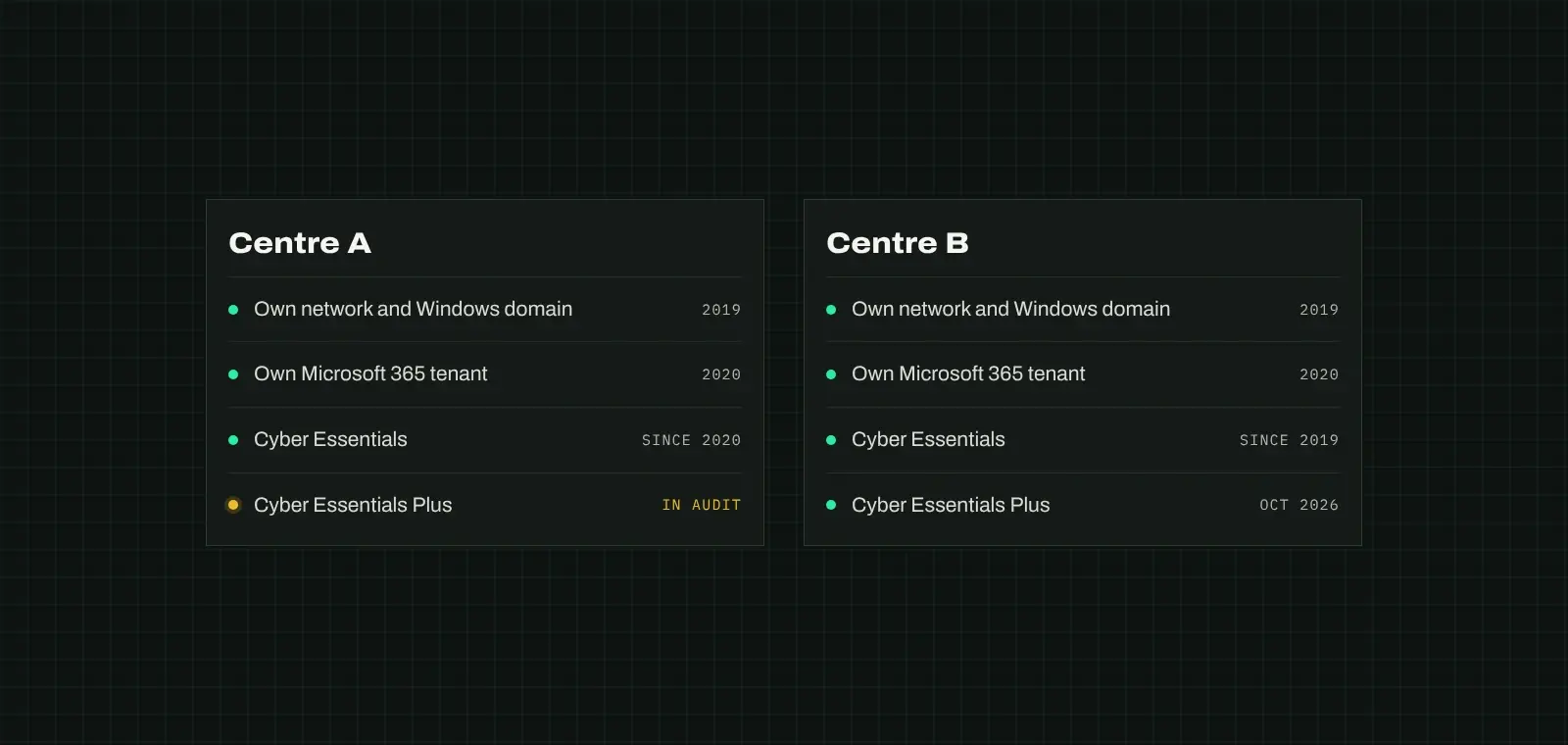
Cyber Security · London · since 2019
From the manufacturer’s network to Cyber Essentials Plus
Their own network, Microsoft 365 and on-site IT when the manufacturer stepped back, then Cyber Essentials every year and Cyber Essentials Plus in 2026.
Two London Toyota centresRead case study
Free IT & security cost review
Find out what an attacker could reach.
Send us your current IT, security, phone and CCTV costs. Within two working days a senior engineer sends back a written comparison showing where you are overpaying and what we would change. No obligation, no sales script.
- Reply within one working day
- Fixed prices, in writing
- A senior engineer, not a salesperson