
Most local businesses can be impersonated by email
Every business that sends email publishes a few public settings that tell the world’s inboxes which email really comes from it. The most important, DMARC, tells receiving mail servers to reject a message that claims to be from you but isn’t. Without it switched on and set to enforce, most fakes are delivered.
Only 82 of the 389 businesses we checked (21%) had DMARC enforcing. The other 307 had no DMARC record, a monitor-only record that blocks nothing, a broken record, or enforcement that covers only part of their email.
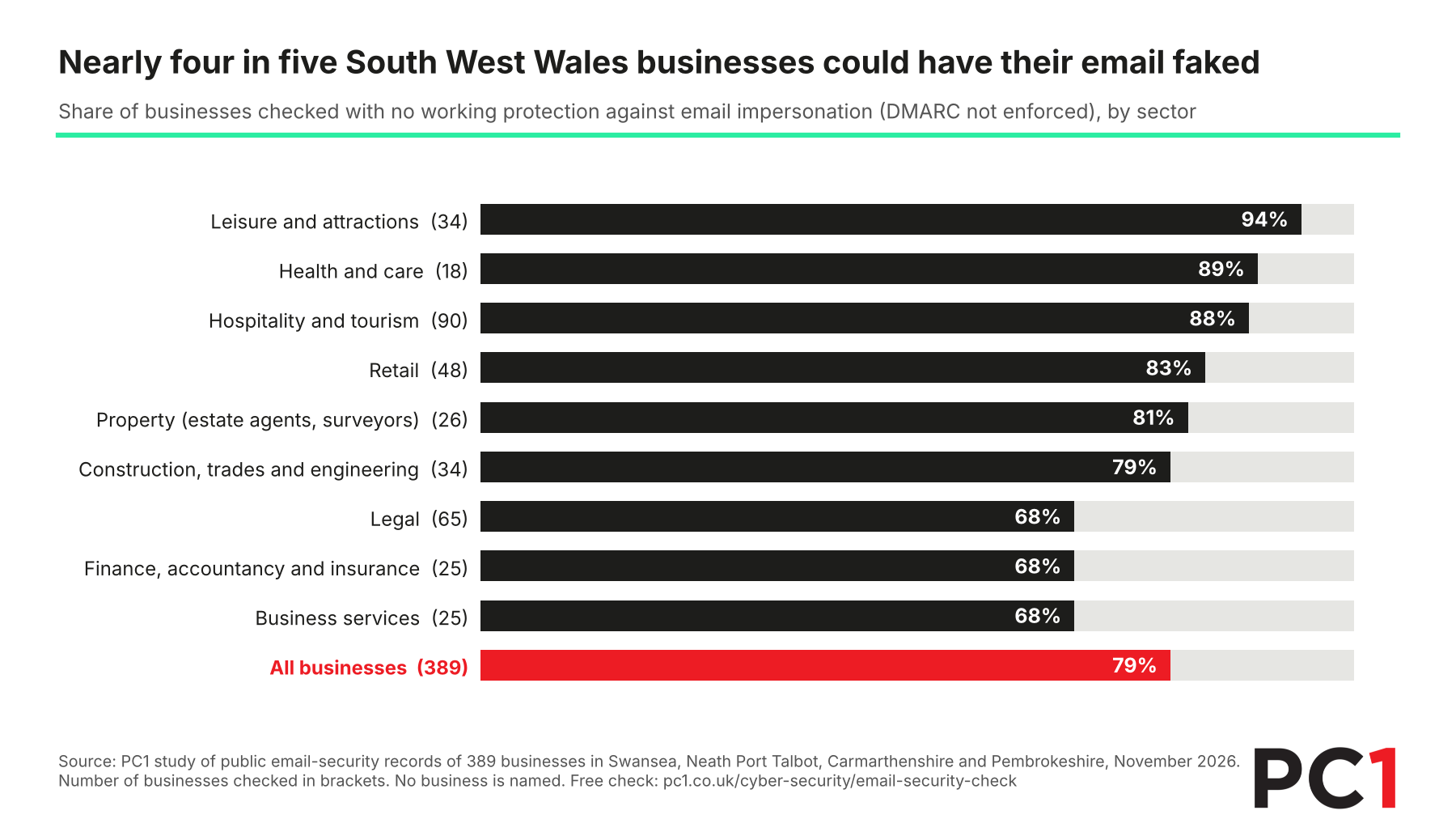
Leisure, health and hospitality were the most exposed
| Sector | Checked | Exposed | Share exposed |
|---|---|---|---|
| Leisure and attractions | 34 | 32 | 94% |
| Health and care | 18 | 16 | 89% |
| Hospitality and tourism | 90 | 79 | 88% |
| Retail | 48 | 40 | 83% |
| Property (estate agents, surveyors) | 26 | 21 | 81% |
| Construction, trades and engineering | 34 | 27 | 79% |
| Legal | 65 | 44 | 68% |
| Finance, accountancy and insurance | 25 | 17 | 68% |
| Business services | 25 | 17 | 68% |
| All businesses | 389 | 307 | 79% |
Sectors with at least 18 businesses checked. The total also includes smaller groups not shown separately: motor, recruitment, charity and IT firms. Solicitors, estate agents and accountants did a little better than average, but they handle large client payments, so two in three being exposed is still a serious gap.
A fake invoice from a real address gets paid
One of the commonest frauds facing small firms is simple: an email that appears to come from a supplier you already trust, with an invoice or a note that their bank details have changed. Because it comes from an address you recognise, it is far more likely to be paid. Without DMARC, criminals can send exactly that email in your name to your customers.
The UK Government’s Cyber Security Breaches Survey 2025/2026 found that 43% of UK businesses suffered a cyber breach or attack in the past year, with phishing the most common type.
“Most owners we speak to assume their email is protected because they pay for Microsoft 365 or Google. It usually isn’t. The setting that stops criminals sending email in your name, DMARC, is free, but it has to be switched on and set up in the right order. For most businesses it’s about an hour’s work, and it closes the door on one of the commonest frauds there is.” Graham Thomas, Managing Director, PC1.
DMARC closes one door, not all of them
DMARC stops criminals sending email that forges your exact domain, once it is set to enforce. It mainly protects your customers and suppliers from fake emails in your name. Your own inbox is protected by the filtering in your mail system, and that is a separate job.
It does not stop a lookalike domain (for example examp1e.co.uk), because the criminal owns that domain and can set it up properly. It does not stop a scammer using your director’s name on a webmail address, or a genuine mailbox that has been hacked, because those emails are not forged. The UK National Cyber Security Centre treats anti-spoofing as one of four layers, alongside spotting and reporting phishing, limiting the damage and responding quickly.
- Switch on multi-factor authentication for every mailbox.
- Turn on impersonation protection for directors and finance staff in Microsoft 365 or Google Workspace.
- Check bank-detail changes by phone, every time.
- Report suspicious emails to report@phishing.gov.uk and texts to 7726.
Three things to do before Christmas
- Check your own domain. Our free email security check gives an instant A to F grade from your website or email address, with no sign-up.
- Ask your IT provider about SPF, DKIM and DMARC. The three work together, and DMARC set to quarantine or reject is what actually stops fakes. If you have no IT provider, we set it up for one domain on Microsoft 365 or Google Workspace for £75 + VAT until 31 January 2027. We move to enforcement once your genuine senders, such as your invoicing system and newsletter tool, are lined up, so your own email keeps arriving.
- Check bank-detail changes by phone. Whatever your settings, ring a supplier on a number you already hold before paying a new account.
Public records only, with no business named
In November 2026 we read the public email-security records (DMARC, SPF and MX) of 415 businesses in Swansea, Neath Port Talbot, Carmarthenshire and Pembrokeshire. 393 had a working web address, and four of those returned no readable email records, leaving 389 in the study. Businesses came from public sources: the Law Society’s Find a Solicitor directory, OpenStreetMap business listings and public web listings. PC1’s own customers were left out.
We read only the records that every mail server in the world checks when it receives an email. No business’s systems were accessed, nothing was sent to anyone, and we are not naming any business. A list of firms whose email can be faked would be a ready-made target list for fraudsters. Any business can check its own result with our free checker, or ask us and we will go through it privately.
“Exposed” means a criminal could send email forging the business’s exact address without DMARC telling inboxes to reject it. It does not mean the business has been defrauded. We will rerun the study in the new year and publish the change.